
![National Museum of African Art, Smithsonian Institution. “Smithsonian Learning Lab Resource: Lamidi Olonade Fakeye, at work, Ibadan, Nigeria, [negative].©Eliot Elisofon Photographic Archives, National Museum of African Art](https://images.squarespace-cdn.com/content/v1/695a8a5e0efc5b7d644ecdc8/1237a975-c472-4887-8059-7d2f786f2261/NMAfA-EENG-II-4_01A.jpg)
Icons | Lamidi Fakeye
Lamidi Olonade Fakeye (1928–2009) profoundly shaped the trajectory of modern Nigerian sculpture, emerging as one of the most influential woodcarvers of the twentieth century. Born in Ila-Orangun, in present-day Osun State, Nigeria, Fakeye was a fifth-generation sculptor, descending from a long lineage of Yoruba woodcarvers. His father, Akobi Ogun Fakeye, passed down to him not only the technical skills of the craft, but also a spiritual and cultural inheritance that connected him to four generations of ancestral artistry. Fakeye’s earliest memories of the workshop are etched with confidence and curiosity, as he fearlessly navigated sharp tools and began fashioning small household items and toys.
In 1949, Fakeye joined the Oye-Ekiti workshop, established by the Irish Catholic priest and architect, Father Kevin Carroll. This mission-based art center exemplified the hybrid art environments of the colonial era, where African artisans encountered Western religious iconography and classical European styles. Under the guidance of Carroll and local cleric-artist Arowoogun, Fakeye participated in a creative milieu that encouraged experimentation, especially in the production of Christian liturgical objects and ecclesiastical architecture. Despite the European framing of these projects, Fakeye’s carvings remained grounded in Yoruba aesthetics and cultural symbolism. He did not mimic; he translated.
Fakeye’s international recognition grew steadily from the 1960s onward. In 1978, he was invited to serve as artist-in-residence at Western Michigan University in the United States, a role he returned to in the 1980s and 1990s. His ability to teach, lecture, and engage students across cultures deepened his impact and further positioned him as a global ambassador of Yoruba art. In 1989, the Smithsonian Institution honoured Fakeye as a “Master of African Art” as part of its Masters of African Art series—a testament to his stature and influence on the world stage.
Lamidi Olonade Fakeye died in 2009, leaving behind a legacy carved not only in wood but in history. His sculptures remain in private collections, national museums, churches, and public buildings across Nigeria and beyond. Through his hands, blocks of timber became vessels of story, spirit, and survival—offering us a world in which the past is always alive in the present.
Excepts from text by Dr Jareh Das, an independent curator, scholar and (occasional) florist who works between West Africa and the UK.
The death of Fakeye’s father during his youth marked a turning point in Fakeye’s early life. Eager to deepen his training, he journeyed to towns such as Ibadan and Iseyin, where he apprenticed under the accomplished sculptor George Bamidele Arowoogun.
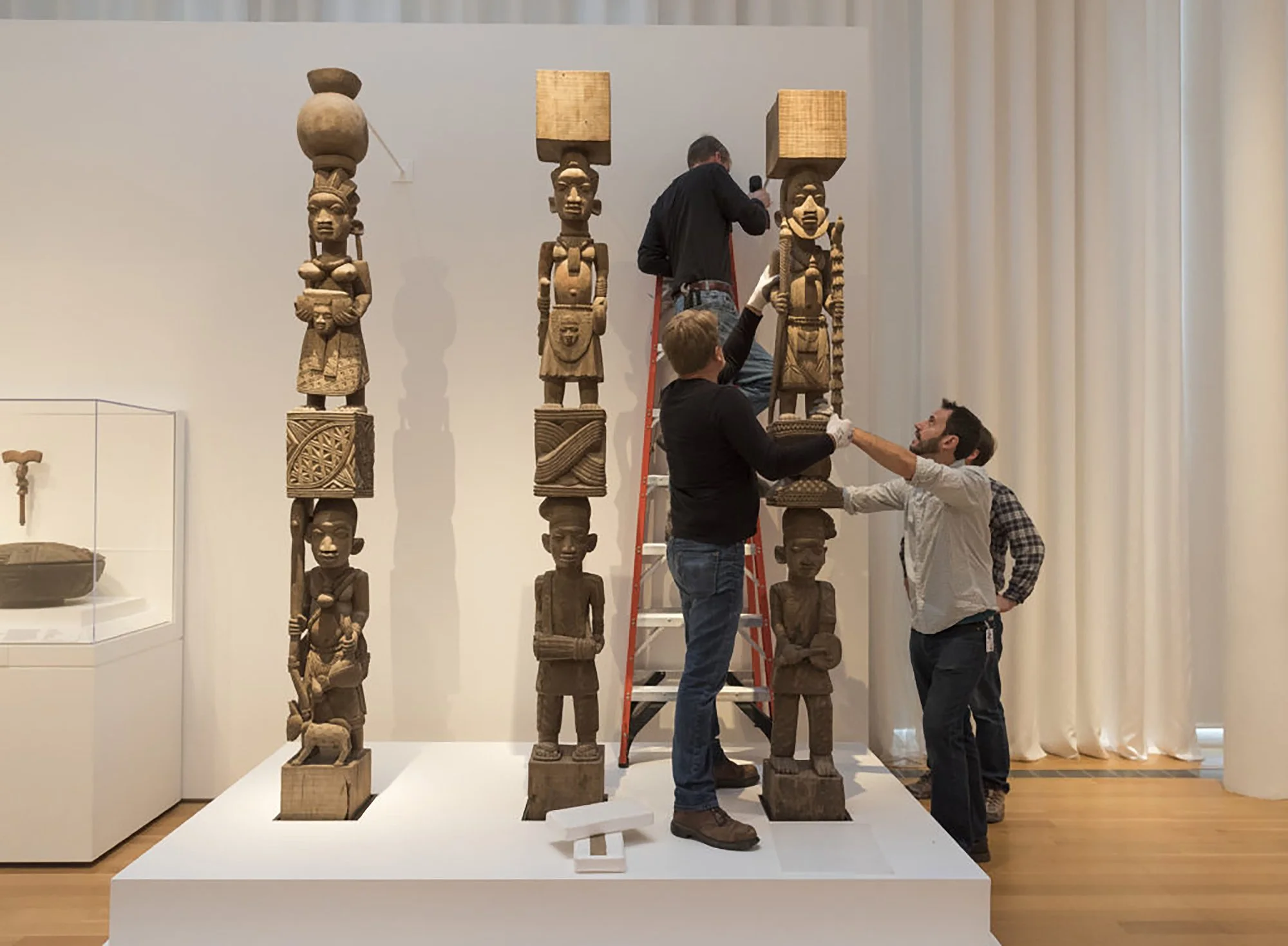
Three Veranda Posts by Lamidi Fakeye in the permanent collection of the North Carolina Museum of Art. Image © The North Carolina Museum of Art
Fakeye’s practice continued to evolve as he found ways to incorporate Yoruba mythologies, spiritual traditions, and social histories into his sculptures; Working predominantly with iroko and mahogany.
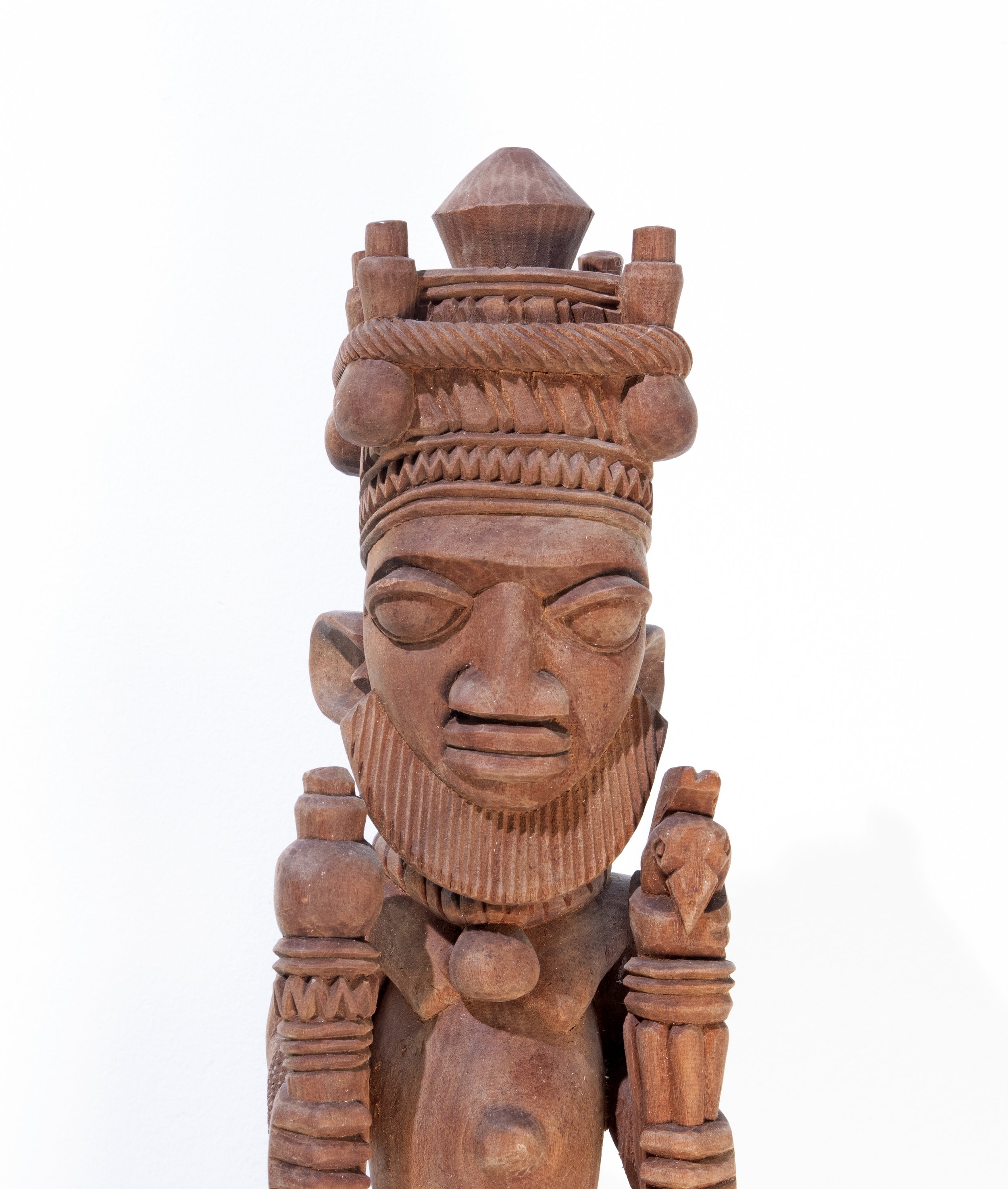
Untitled (Baba Ifa) exhibited at Icon | Lamidi Fakeye in TAFETA London, April 2025

Fakeye’s “The Yoruba Transfiguration,” 2007 featured in a 2020 New York Times article
Fakeye’s generation also included artists like Uche Okeke, Bruce Onobrakpeya, and Demas Nwoko, who were instrumental in the Zaria Art Society and the formulation of “Natural Synthesis,” an artistic philosophy that called for a fusion of indigenous forms with Western techniques.
Fakeye’s international recognition grew steadily from the 1960s onward. In 1978, he was invited to serve as artist-in-residence at Western Michigan University in the United States, a role he returned to in the 1980s and 1990s.
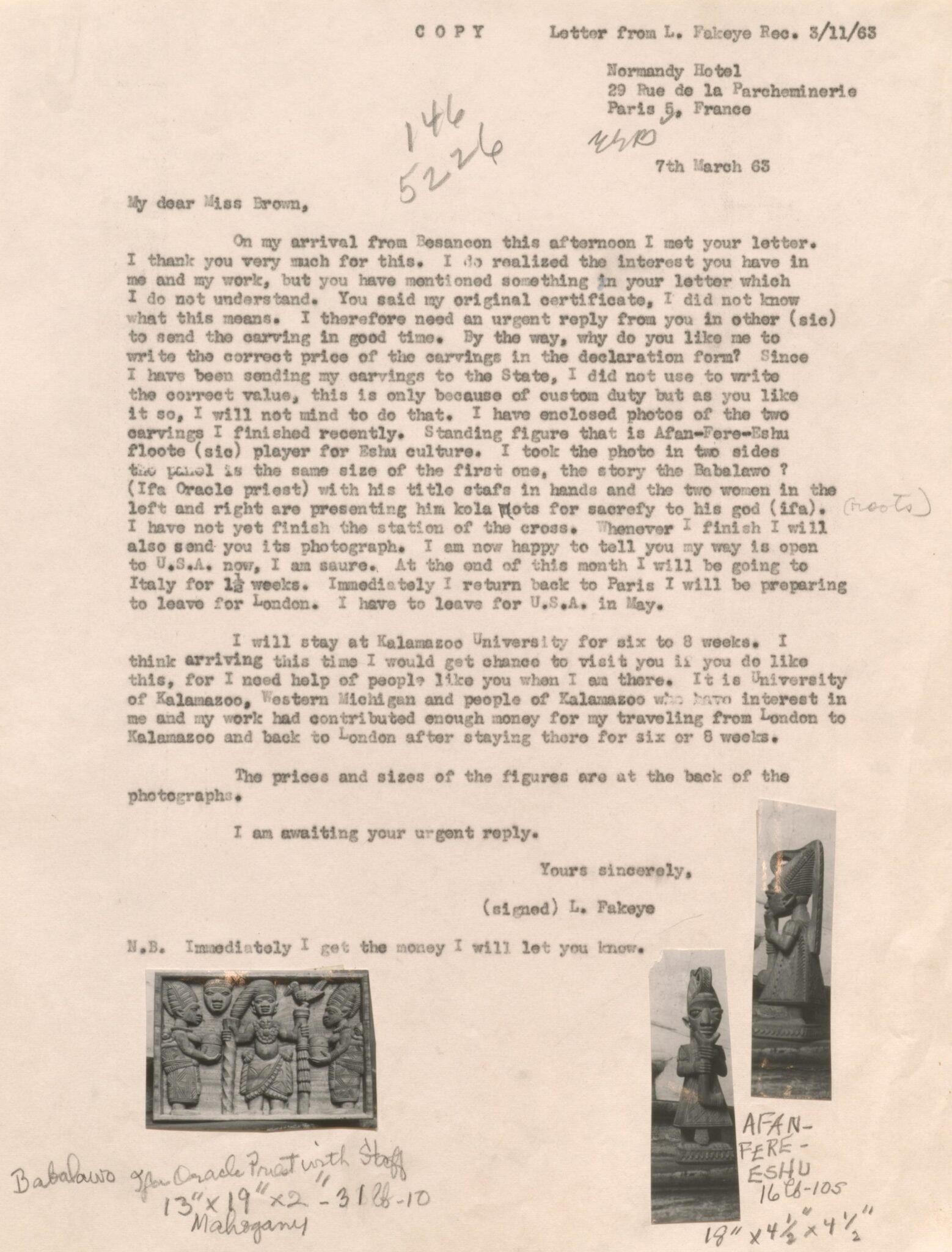
Letter from Lamidi Fakeye to Evelyn Brown (Assistant Director of the Harmon Foundation). From Library of Congress, Harmon Foundation, Inc., Records 1913–1967.